One year ago, Amenta Emma signed the AIA Materials Pledge, committing to design with materials that prioritize human health and reduce our impact on the climate. This Earth Day, we’re proud to share that our Boston office at 285 Summer Street is the first project we’ve formally reported through the Pledge – a milestone that feels especially meaningful because we began with ourselves.
Applying the same standards to our own studio that we hold for our clients’ projects is how we demonstrate that sustainability isn’t a service we offer. It’s how we work.
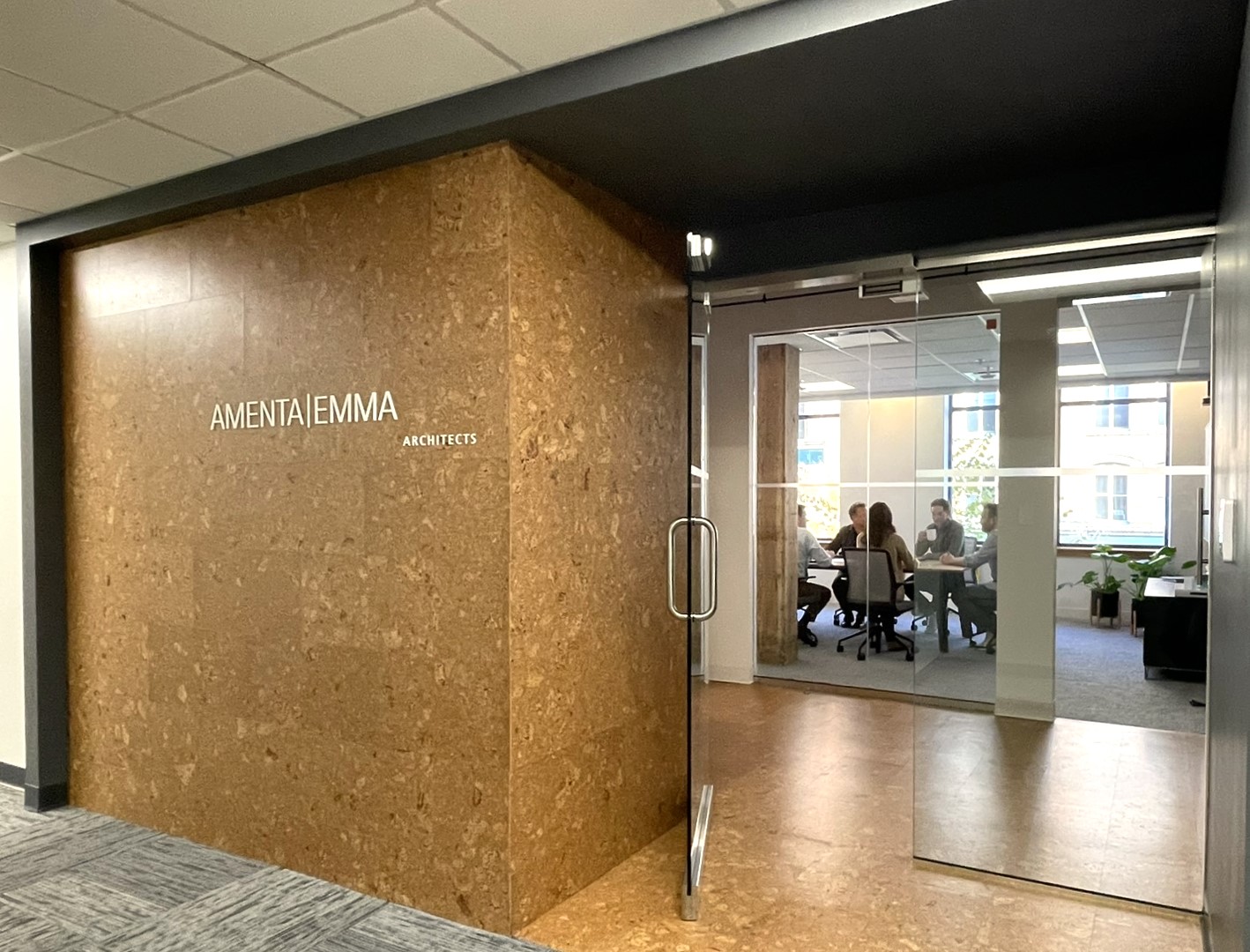
Amenta Emma Boston studio at 285 Summer Street.
Putting the Pledge into Practice
Reuse and Waste Diversion
We started with reuse as a guiding design principle, not a secondary consideration. Before a single new item was specified, we surveyed the space, cataloged every door, partition, and light fixture, and built the design around what was already there. Existing interior wood doors and glass partitions were salvaged and incorporated into the new conference spaces and wellness room. Kitchen and copy area millwork, countertops, and backsplash were retained. We kept or relocated all existing light fixtures. The open space was designed to allow for the reuse of our existing workstations. Common area furniture was partially sourced from a local vendor specializing in gently used office furnishings.
We also challenged ourselves to design a focal point that tells a story. The result is a feature wall designed and built in-house using cardboard tubes from plotter paper rolls – a material familiar to every design firm, and one that typically ends up in the recycling bin. The installation now serves as a modular display system for models and samples and has become one of the defining elements of the space.
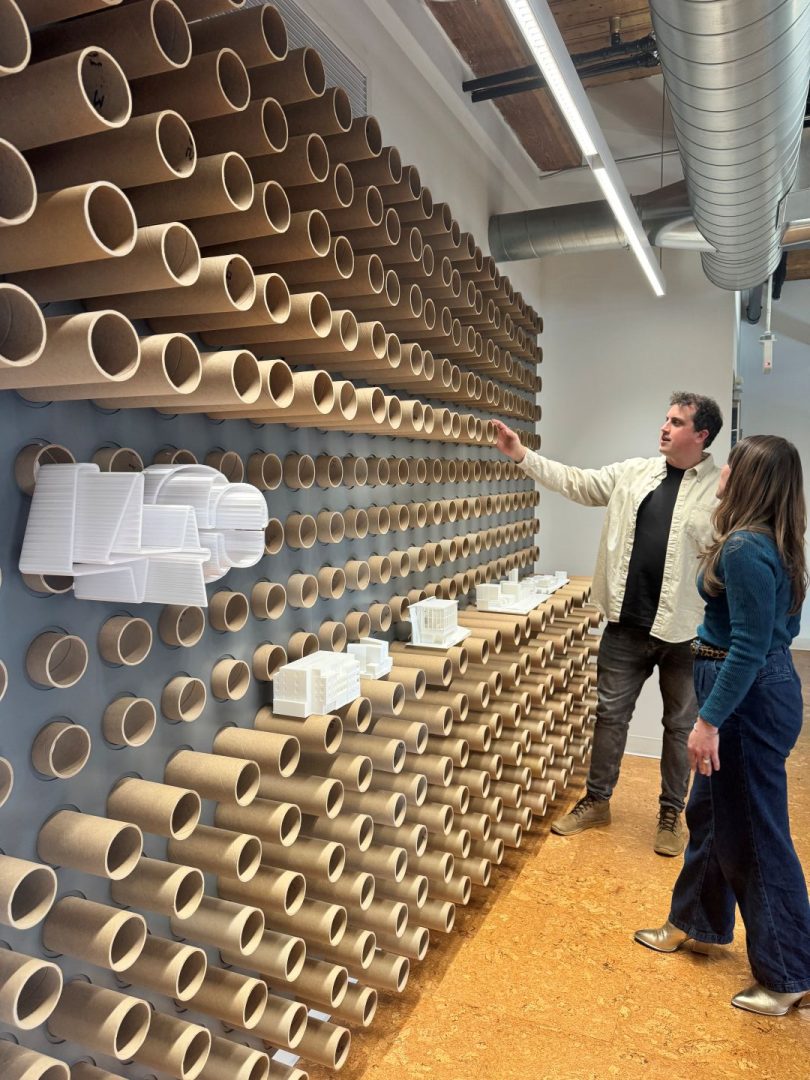
Feature wall constructed from salvaged plotter paper tubes, now serving as a modular model and sample display.
Material Selection
Every new material was evaluated through the framework of the AIA Materials Pledge. All newly specified interior finishes – including carpet, paint, and cork flooring – align with the Pledge’s principles of Human Health and Climate Health. The project also prompted us to revisit and sharpen our materials library, applying the same lens to what we keep on hand and recommend to clients going forward.
Biophilic Design
The building’s exposed timber structure – heavy timber columns and wood ceiling – is a defining architectural element, one that brings warmth and a tangible sense of history to the space. Rather than treating plants as decor to be added later, we designed locations for plantings at the outset, integrating them into millwork, partitions, and shared areas from the beginning. The result is a studio where biophilic principles aren’t incidental – they’re woven into how the space was conceived.
Why This Matters
Sustainability is often approached as a project-specific exercise – a checklist, a certification threshold, or a client requirement. We believe it must be more fundamental than that. It should be embedded in how we operate, how we design our own spaces, and how we make everyday decisions about what we use, retain, and replace.
Our Boston studio is a direct expression of that commitment – and the first of many projects through which we intend to report and refine our practice.