Renovating campus dining halls within occupied buildings demands a fundamentally different approach than new construction. Beyond the technical challenges of working within fixed footprints and aging infrastructure, these projects require balancing operational continuity with social programming ambitions. Recent dining hall renovations at Bryant University, UConn, and Quinnipiac University offer valuable insights into navigating these complexities while achieving exceptional results.
Operational Continuity as a Strategic Design Factor
Maintaining dining operations during construction presents one of the most significant challenges in campus renovations. At UConn’s Putnam Refectory, the university required continuous dining service for nine months of the 14-month construction schedule, even as we cut a large opening between floors, replaced major building systems, and completely renovated the interior.
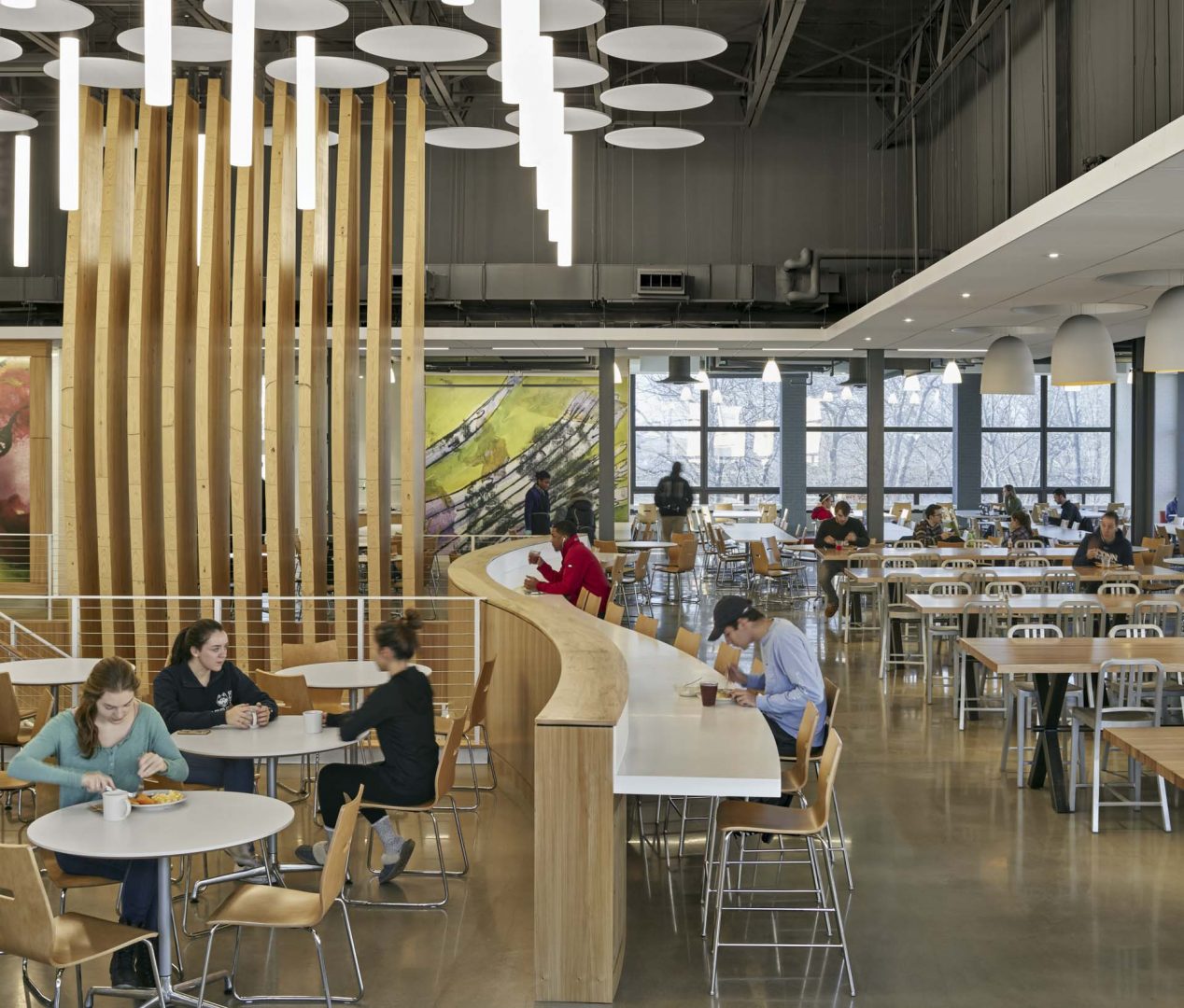
At UConn’s Putnam Refectory, the university required continuous dining service for nine months of the 14-month construction schedule.
This operational requirement shaped our design approach from the outset. The key to success was establishing dining services leadership as active partners throughout the entire process. Their representatives attended nearly all planning, design, and construction meetings, enabling real-time problem-solving and ensuring operational feasibility at every decision point. Additionally, our construction partners were essential to a strategic approach to demolition, construction, and equipment installation that was based around the academic schedule.
Finding Opportunities in Existing Constraints
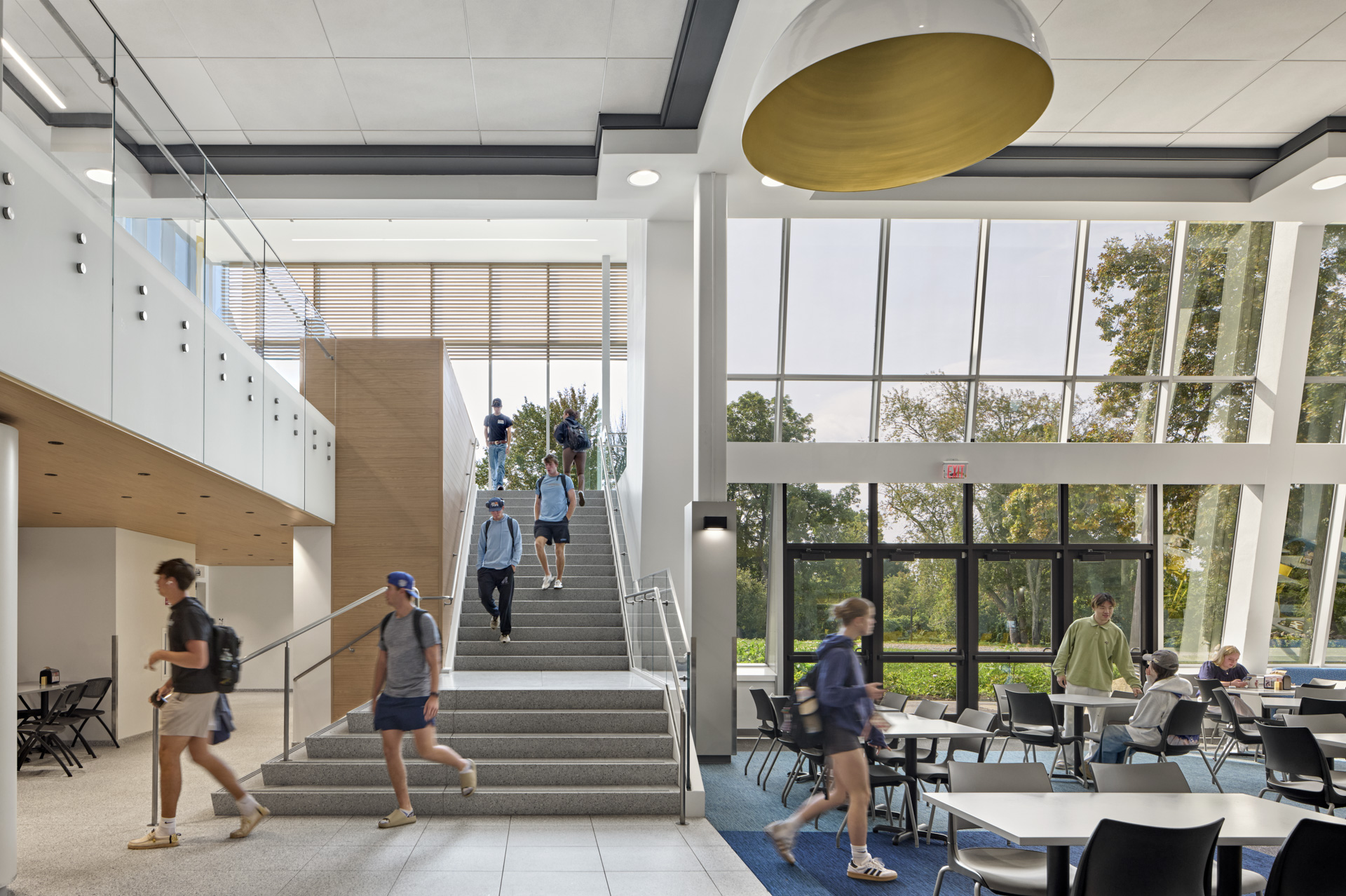
Existing buildings impose specific parameters that demand creative solutions. At Putnam, the challenge was clear: increase capacity from 400 to 700 seats without expanding the building footprint. The solution emerged through careful site analysis, repurposing the underutilized lower level and leveraging the sloping topography to create separate entrances at each level. This approach transformed a single-level facility into an integrated two-story dining that leveraged daylight previously confined to the upper level.
At Quinnipiac’s North Haven campus, the project goal was to increase student use of the dining facility and foster engagement beyond food service. The previous cafeteria space sat adjacent to a picturesque lake outdoor that could be only seen through glass windows. Our renovation approach capitalized on this asset by including an outdoor seating area that can be accessed from the dining hall. What was once simply a great view is now a lively outdoor space for student gathering during all hours of the day.
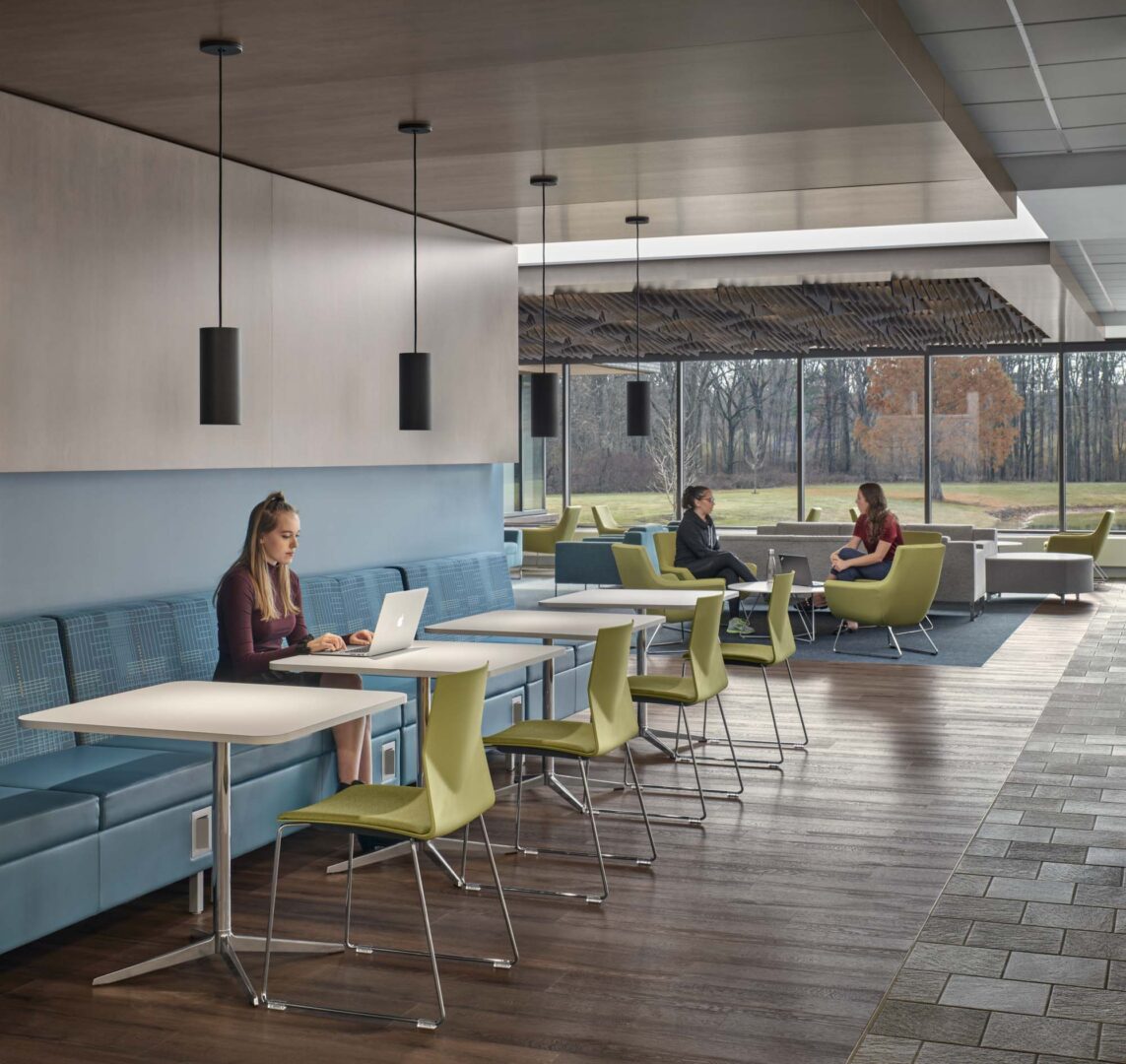
High-impact interventions, like acoustic baffles suspended from a wooden ceiling canopy, maximized existing assets at Quinnipiac University’s North Haven Campus Dining Hall.
Addressing Infrastructure Realities Through Comprehensive Planning
Aging buildings inevitably reveal hidden challenges during construction. Bryant’s Salmanson Dining Hall (1970) and UConn’s Putnam Refectory (1969) facilities both required extensive infrastructure modernization beyond their visible architectural updates. These discoveries underscore the critical importance of thorough predesign investigation.
At Putnam, we invested significant time in existing conditions analysis, testing multiple design approaches, and developing detailed cost estimates before finalizing our approach. This planning phase proved invaluable for establishing realistic project priorities and managing stakeholder expectations across facilities, engineering, dining services, and student life.
For Salmanson Dining Hall, an extensive investigation was required to fully understand the condition and capacity of underground utilities serving the space. Comprehensive field investigation coupled with X-ray scanning allowed the design team to have an accurate picture of possible hidden complexities that would have otherwise slowed construction. Converting the information scanned from below the slab to BIM allowed the engineering team to tactically plan integration with new services to minimize demolition and costs.
Creating Contemporary Environments for Evolving Student Needs
Today’s campus dining halls serve multiple functions beyond food service; they are spaces for studying, socializing, and community gathering. At Quinnipiac, we transformed a former corporate cafeteria into a multi-use space for dining and student engagement throughout the day. This light-touch approach focused on maintaining dining seating capacity, while introducing various zones and spaces with unique furnishings and lighting to provide students with choices for gathering. The dining hall is now utilized for variety of functions beyond eating, by individuals and student groups.
At Bryant’s Salmanson, we employed a similar strategy to transform the dining hall into a destination for student gathering. The ubiquitous table and seats were replaced with a variety of types and scales to appeal to different social inclinations about community and privacy. Additionally, accessibility to the dining hall was enhanced through an addition featuring a new elevator and clearly identifiable entrance to the main campus quad. These changes now re-focus the dining hall as an inclusive destination on Bryant’s campus, suited for food service as well as student lounge space for congregating.
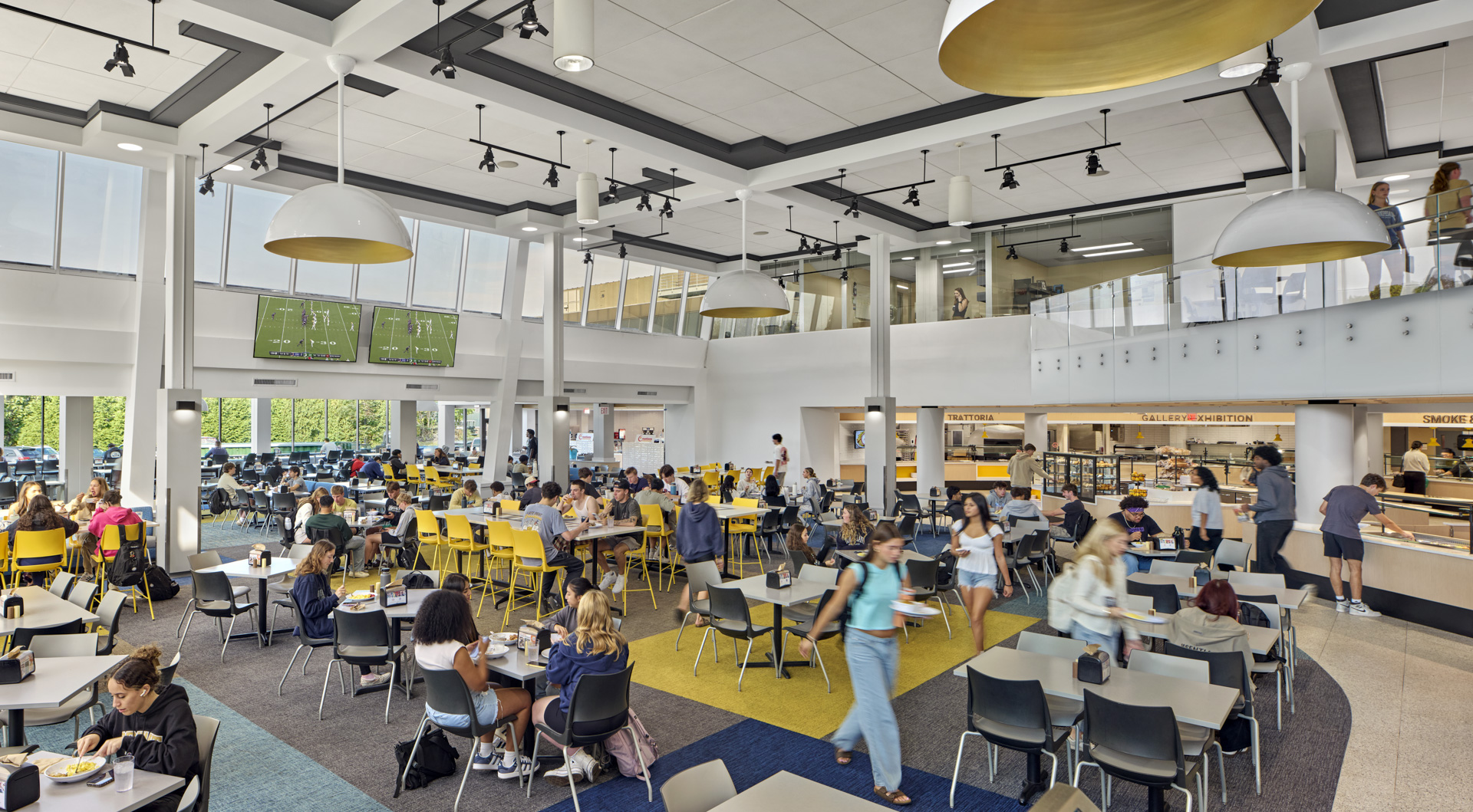
At Bryant University’s Salmanson Dining Hall, the ubiquitous table and seats were replaced with a variety of types and scales to appeal to different social inclinations about community and privacy.
Building Consensus Through Transparent Engagement
Complex campus renovations involve diverse stakeholders with legitimate but often competing priorities. At Putnam, we established transparency as our guiding principle, consistently checking major decisions against the university’s stated objectives and reviewing them with representatives from facilities, engineering, dining services, and student life.
This inclusive approach proved particularly valuable when difficult budget decisions arose. Because stakeholders had participated throughout the process, they understood the rationale behind trade-offs and remained invested in the project’s success. The buy-in we developed during planning and design phases carried through to construction, when unexpected challenges required collaborative problem-solving.
Lessons Learned
These projects demonstrate that renovation constraints – operational continuity, fixed footprints, aging infrastructure – need not limit design ambition. Through comprehensive planning, strategic stakeholder engagement, and creative problem-solving, we can transform outdated facilities into destinations that drive student engagement.
The key lies in embracing constraints as design opportunities rather than viewing them as obstacles. When approached thoughtfully, renovation projects offer opportunities for innovation that may not emerge from blank-slate design.