The streets of Rome changed everything for Tony Amenta.
As a young architecture student studying abroad, he found himself captivated by something he couldn’t quite name at first – the intimacy of narrow streets alive with daily life, neighbors gathering around fountains in the plaza, the simple grace of having your bread, post office, church, and grocery within an easy walk. It was architecture in service of human connection, of community, of place.
Then came Houston.
Fresh out of Notre Dame with his architecture degree in 1977, Tony spent five years working for firms in Texas, including the nationally recognized William T. Cannady, FAIA, Architect. But the sprawling landscape stood in stark contrast to what he’d experienced in Rome. He watched urban and suburban development undermine the human experience – aesthetically, environmentally, and socially. The contrast crystallized his mission: he would dedicate his career to creating the kind of places he’d fallen in love with in Rome.
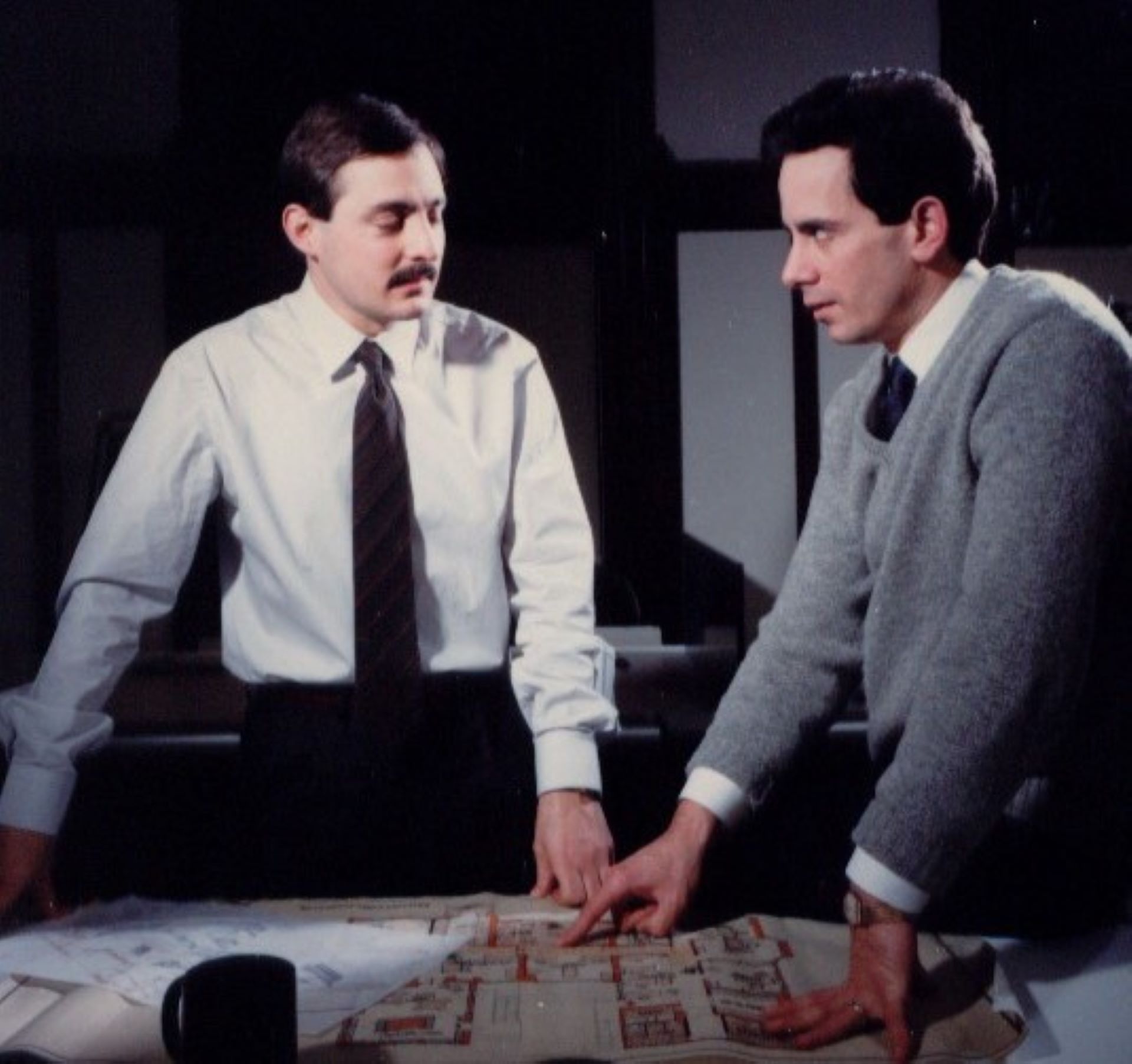
Robert Emma and Tony Amenta – 1985
That mission brought him to Hartford in 1982 to join JCJ Architects. His talent was quickly recognized, and by age 29, he was made Director of Design. A year later, Director of Project Management. But Tony had bigger plans. In 1985, at age 31, he and Robert Emma established Amenta Emma Architects in downtown Hartford, a deliberate commitment to the urban experience and the principles of New Urbanism that would define Tony’s four-decade career.
Now, after 40 years of building not just buildings but communities, Tony has announced his retirement, with his last day set for February 13th, 2026.
“It has been an honor and a privilege to create, build and lead this prestigious and highly regarded design firm,” Tony shared with the team. “I have enjoyed a fabulous career with the firm and have immensely enjoyed every day and every role I have played along the way. Truly, it was never ‘work’ for me but a challenge I always looked forward to.”
Building More Than Buildings
Tony never saw his role as simply designing structures. From the beginning, he rolled up his sleeves and got involved, serving as a trustee on the West Hartford Housing Authority and as chairman of the West Hartford Design Review Committee through multiple terms. Believing that you don’t organize a community through zoning alone, he worked with design professionals and real estate colleagues to write one of Connecticut’s first form-based design review processes. The result: more contextual architecture, more cohesive neighborhoods, and a more walkable community.
West Hartford’s Blue Back Square stands as a formidable example of Tony’s philosophy in action. Acting as the landlord’s architect, Tony and his team created a tenant handbook with form-based guidelines for storefront design, façades, signage, and landscaping. The styles are unique and eclectic, yet harmonious – appearing as if the development had been built over decades rather than years. The firm completed 40 storefronts and built out 30,000 square feet of mixed-use space, creating the kind of live/work/play environment that would have felt at home on those Roman streets. The project’s success sparked a multiplier effect, increasing rental rates and property values throughout West Hartford Center, transforming it into a regional destination.
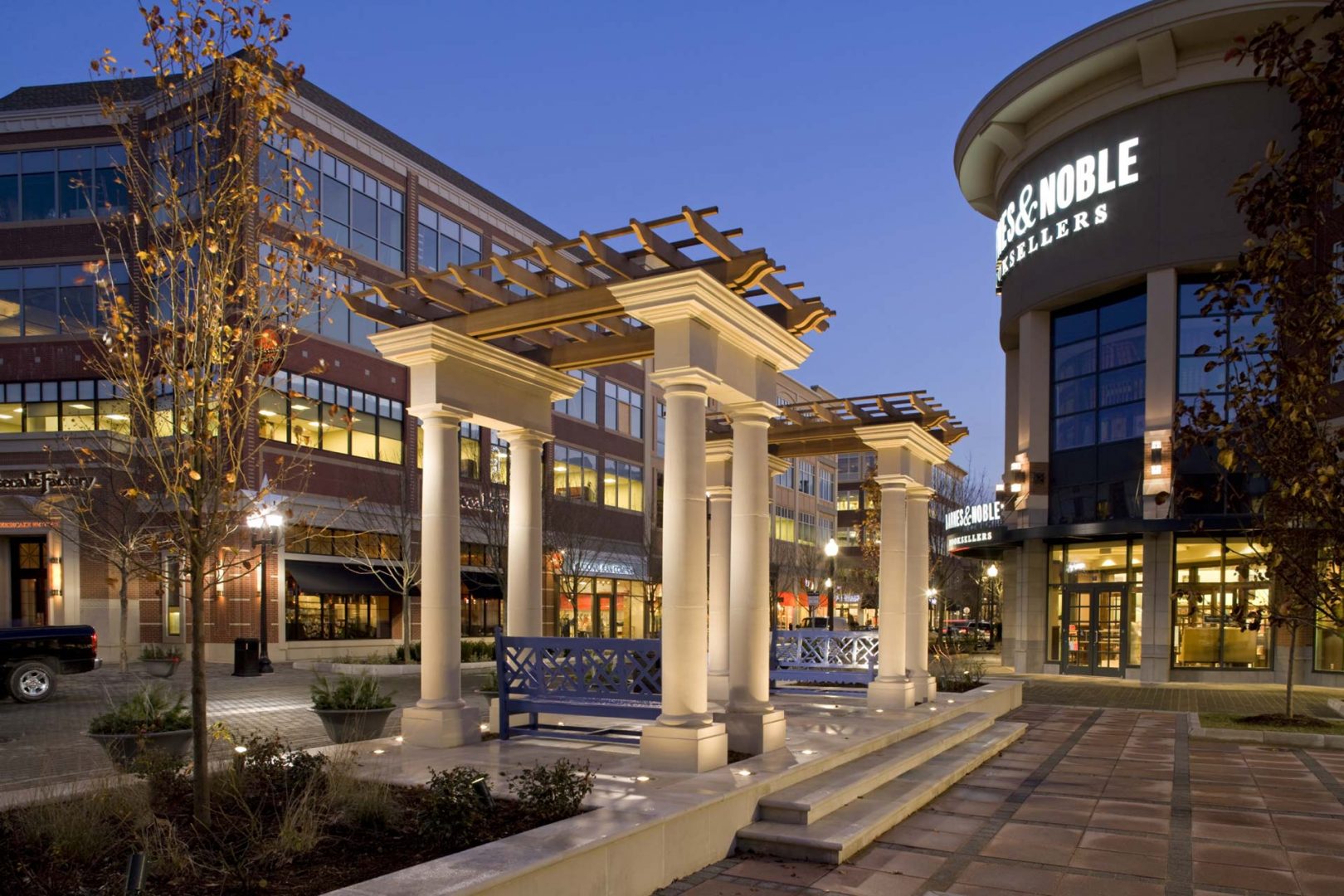
Blue Back Square – West Hartford, CT
Simultaneously, before anyone used the term “collaborative space,” businesses were becoming interested in more open office environments. Tony saw a parallel between these condensed spaces and dense urban environments. He applied this thinking to develop new national standards and office prototypes for a national insurance giant. A key design element was the organization of teams into “neighborhoods” of 10-26 people, connected with a circulation pattern of “city streets.” The plan solved employee alienation by spatially integrating telecommuters into key teams and providing collaborative areas by neighborhood.
That same commitment to creating “sense of place” carried through every project Tony touched, regardless of scale or typology.
At The O’Connell Companies‘ new headquarters in Holyoke, Massachusetts, Tony helped a venerable 140-year-old construction company transition from their historic but undersized downtown structure to a 30,000-square-foot building that honored their legacy while promoting collaboration and synergy. Set on a wooded site, the design conveys permanence worthy of the company’s long history while fitting naturally into its context.
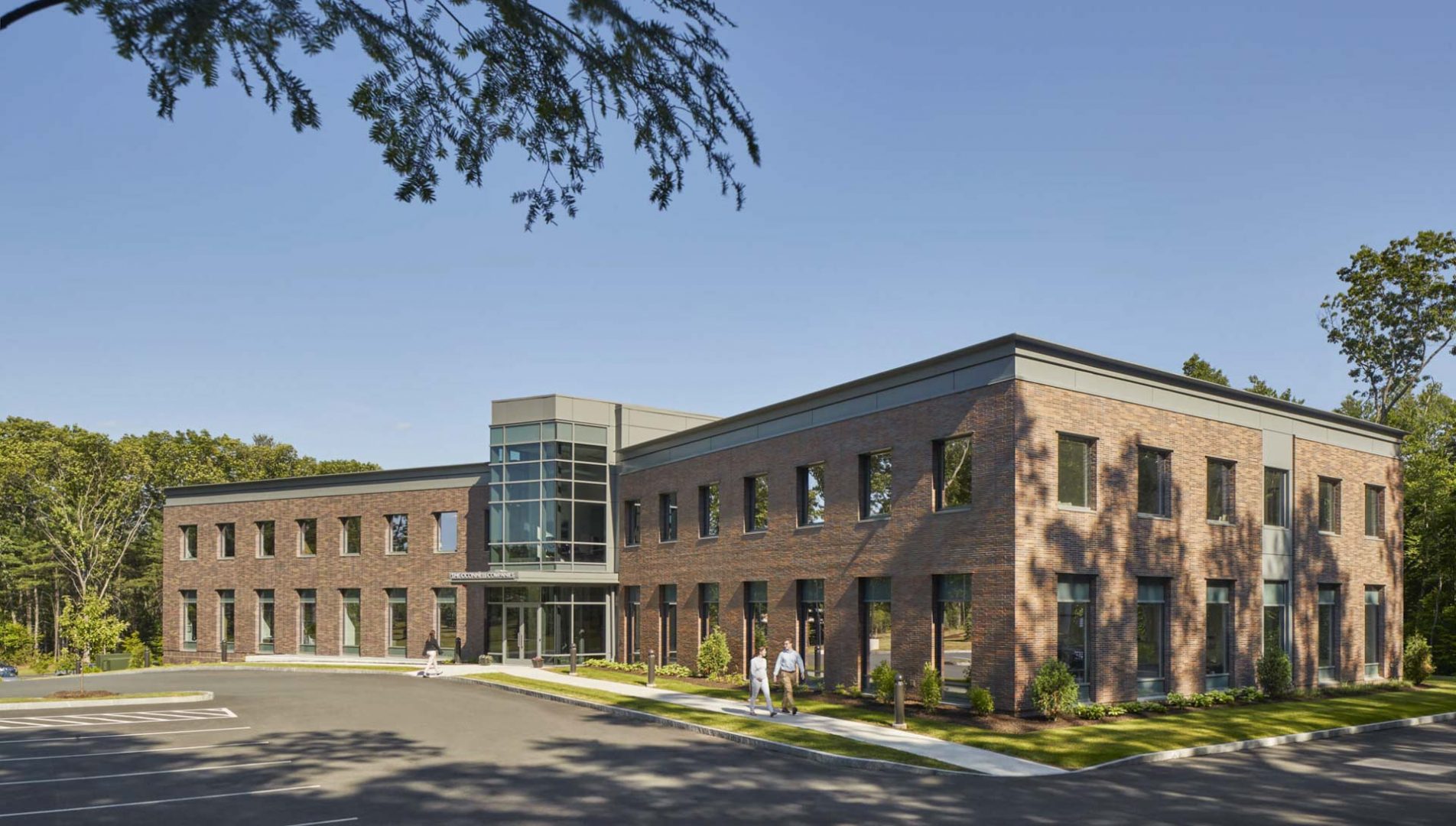
The O’Connell Company Headquarters – Holyoke, MA
At Housatonic Community College’s Lafayette Hall, Tony served as Monitoring Principal for a 48,000-square-foot addition that radically transformed the college’s relationship with downtown Bridgeport. The campus, originally converted from a shopping mall in the mid-1990s, had been set back from the street by a vast concrete plaza, visually lost between abutting structures. The design brought the college boldly to the street: two glazed “boxes” on masonry bases, bisected by a multi-level glazed entry atrium, welcome the public in and put academic life on display. The transparent design creates spaces for public interaction and seamless connection between new and existing areas, with a courtyard that acts as both secondary entry and place for informal community gathering. The LEED Silver-certified project embodies the college’s mission of promoting access and empowerment through education.
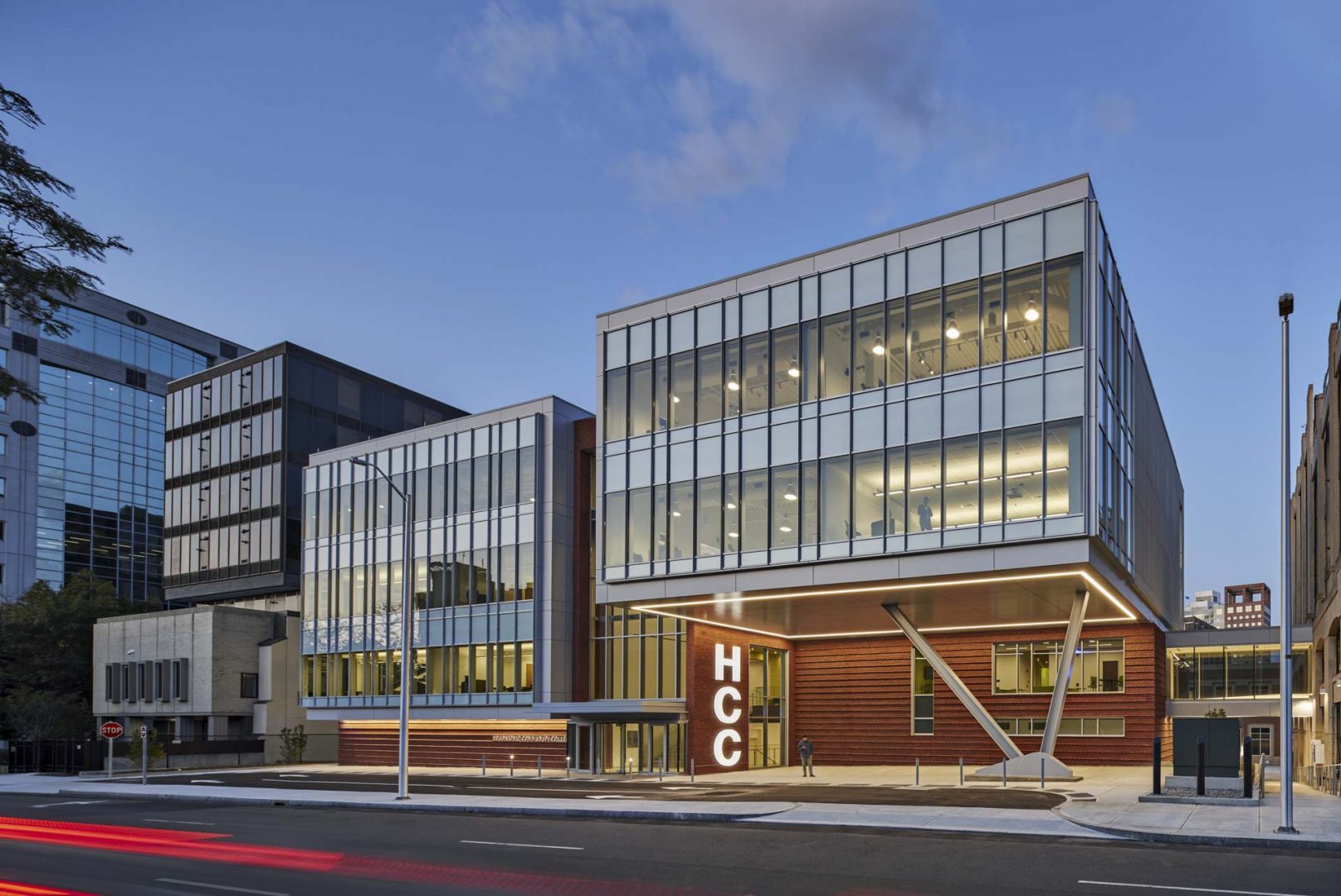
Lafayette Hall at Housatonic Community College – Danbury, CT
The Connecticut State Office Building renovation transformed a 1931 landmark into a vibrant 21st-century workplace while restoring historically significant features. Tony led a team, which included 19 subconsultants, in creating a grand accessible entrance leading to a new two-story lobby, and a river theme that flows through the building, from the park’s paving pattern scaled to represent the Connecticut River from source to mouth, to interior graphics and lobby walls. The project reclaimed the building’s revered civic place in downtown Hartford.
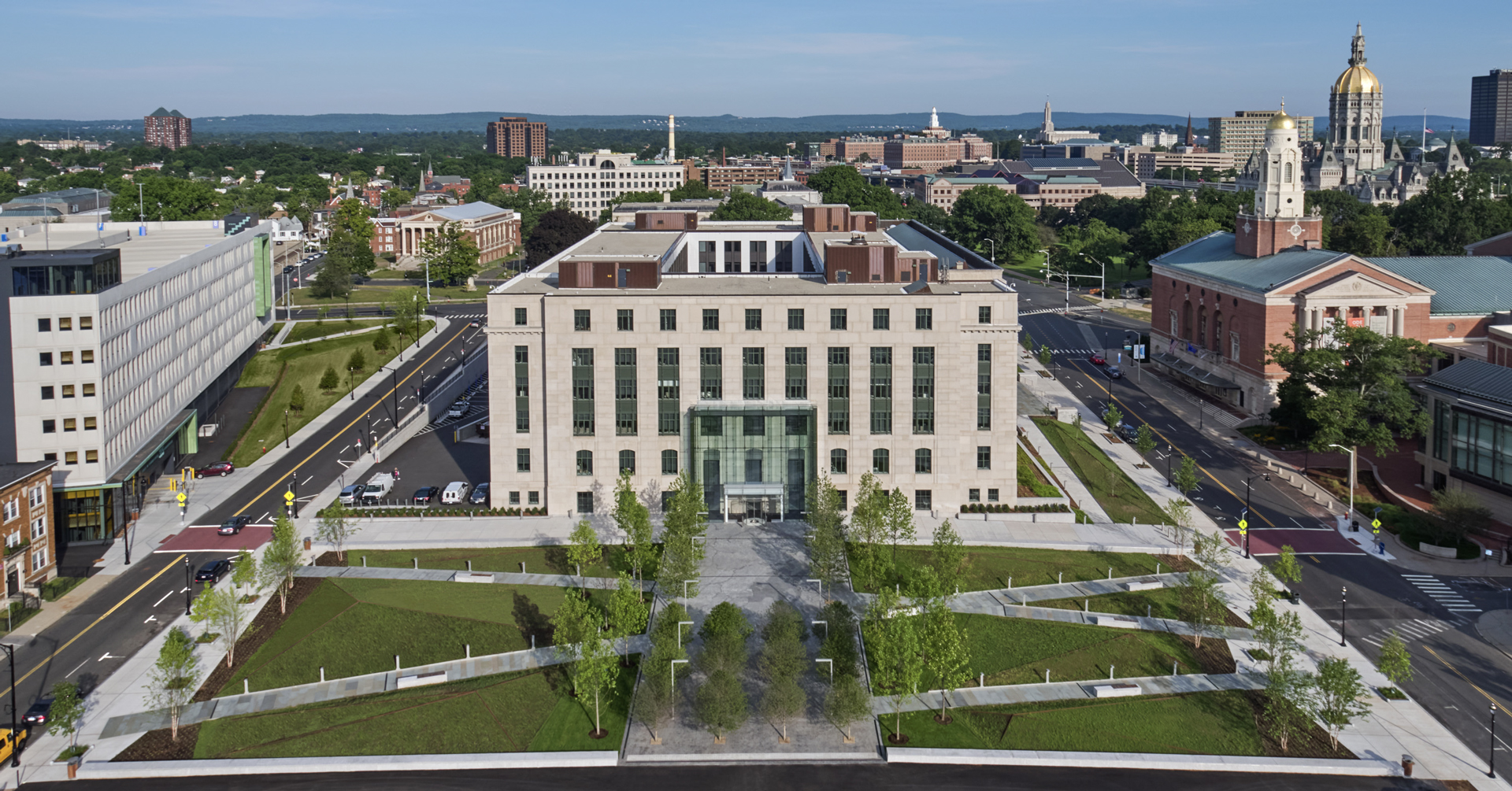
Connecticut State Office Building at 165 Capitol Avenue – Hartford, CT
At 616 New Park Avenue in West Hartford, Tony helped pioneer Connecticut’s first mixed-use development immediately adjacent to a CTfastrak rapid transit stop. The 54-unit project, with market-rate and affordable workforce housing plus units for veterans, features vibrant artwork honoring Connecticut’s transportation history and a lobby designed to activate the street and build community.
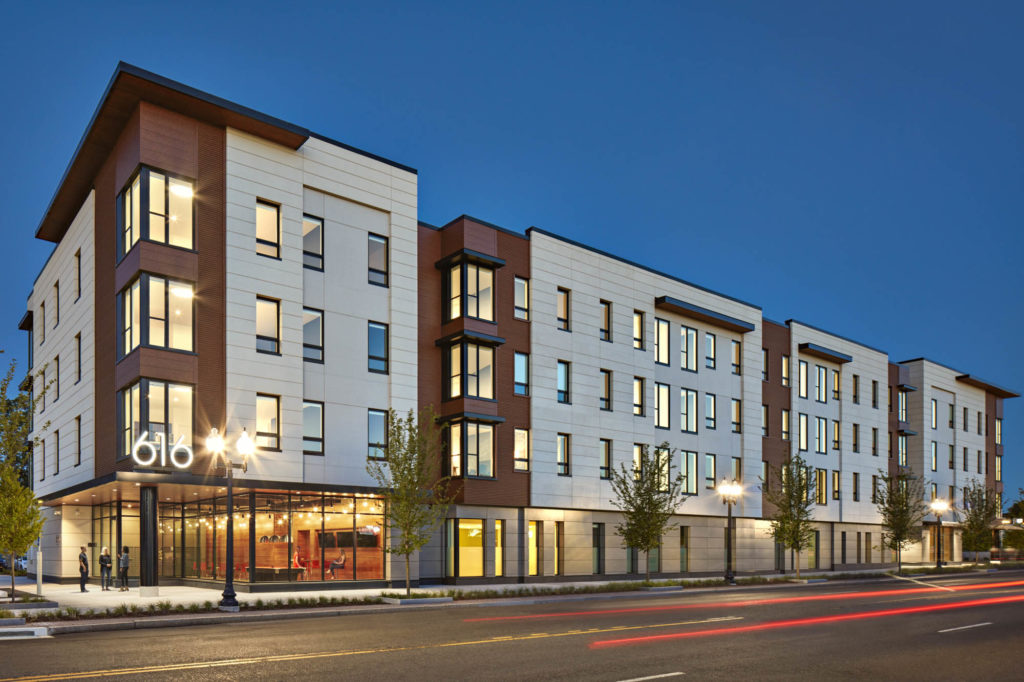
616 New Park Avenue – West Hartford, CT
Other notable projects Tony has spearheaded with his Amenta Emma colleagues include the renovation/addition of Lourdes Hall at the University of Saint Joseph, the Putnam Refectory renovation at UConn, the new Pavilion at Middlesex Community College, the new Town Hall in East Hampton, CT, the lobby renovation of 575 Madison Avenue in NYC, the Furnace Brook Clubhouse in Quincy, MA, the adaptive reuse of an aging retail mall into Woburn Village in Woburn, MA, and multiple corporate headquarters renovations on the Kaman campus in Bloomfield, CT.
President, Michael Tyre, AIA, says, “Tony has been an instrumental force in building Amenta Emma, from the infancy of the firm in Hartford to the more recent expansion of the company in Boston. His commitment to client success and mentorship has been an inspiration to us all, shaping not just our company but the careers of countless individuals. We will deeply miss his unwavering drive, sharp insights, and infectious enthusiasm, but we are incredibly grateful for the wisdom, dedication, and leadership he has shared so generously.”
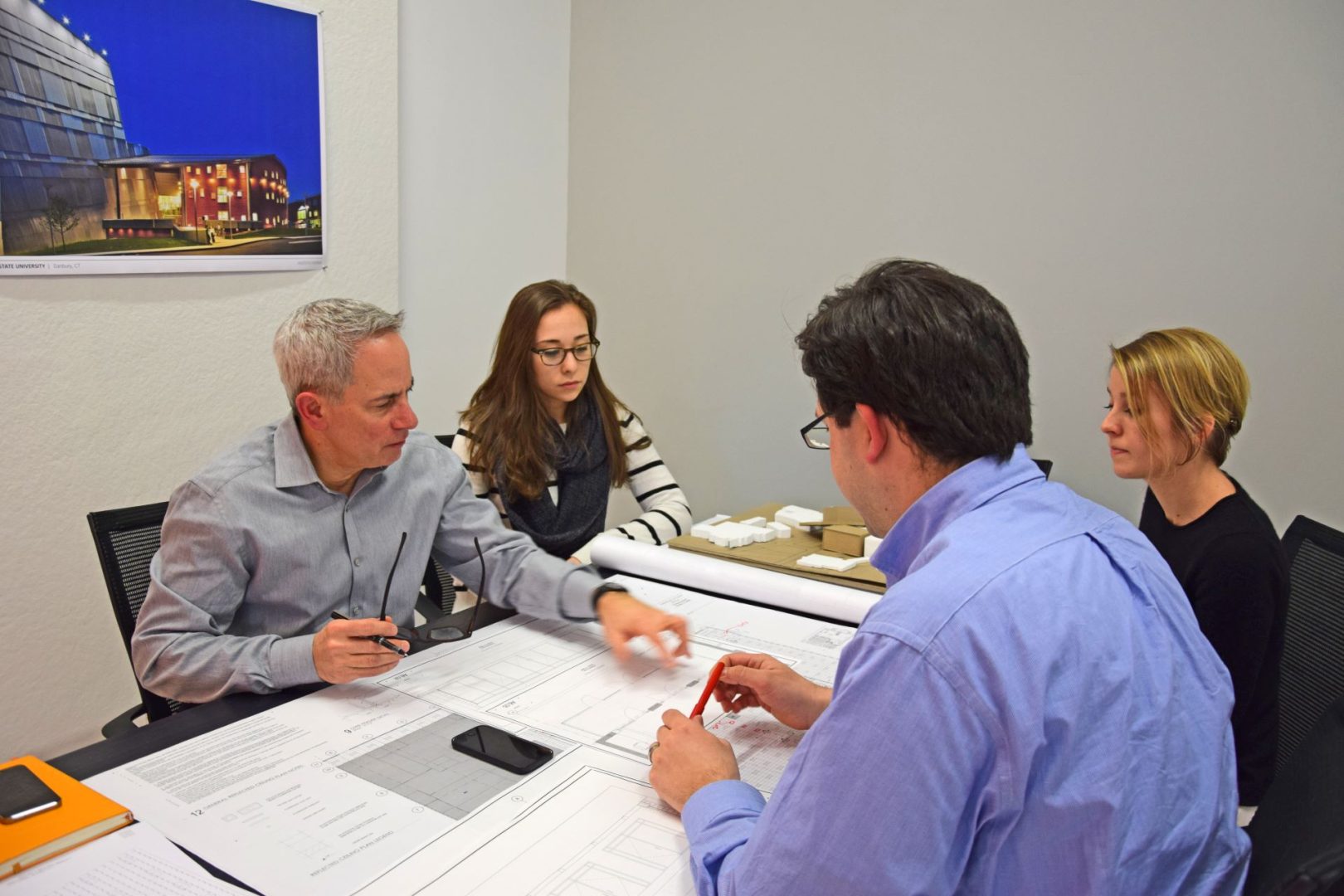
Tony and the 165 Capitol Avenue project team
Legacy of Place and People
The accolades accumulated over the years tell part of the story: AIA Connecticut’s Emerging Architecture Firm recognition in 1987, Connecticut Residence of the Year for the Amenta Residence in 1989, Designer of the Year from the Associated General Contractors of Connecticut in 2016, and the University of Hartford’s Tau Sigma Delta chapter – Gamma Nu Silver Medal in 2023. Tony also served as an adjunct professor at the University of Hartford, teaching fourth-year studio and shaping the next generation of architects.
But perhaps the truest measure of Tony’s impact isn’t in the awards or the buildings – it’s in how those buildings serve the people who use them every day, and in the firm he built to carry that mission forward.
“Together, we have met many challenges, and more. We really have come a long way and are propelled forward for future success,” Tony reflected in his retirement message. “I am so happy to have the relationship I have with so many of you good people. You made my days at Amenta Emma worthwhile and fun!”
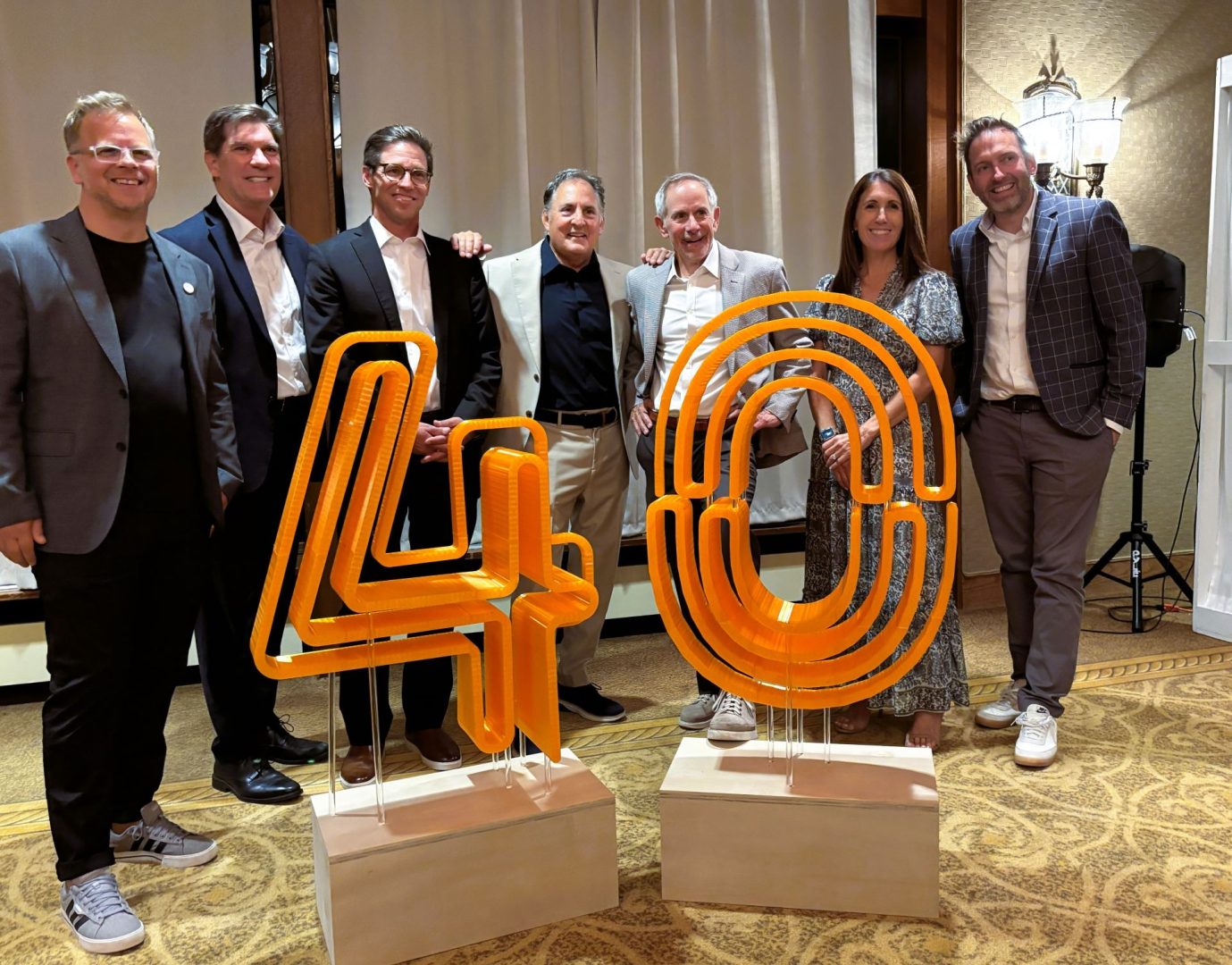
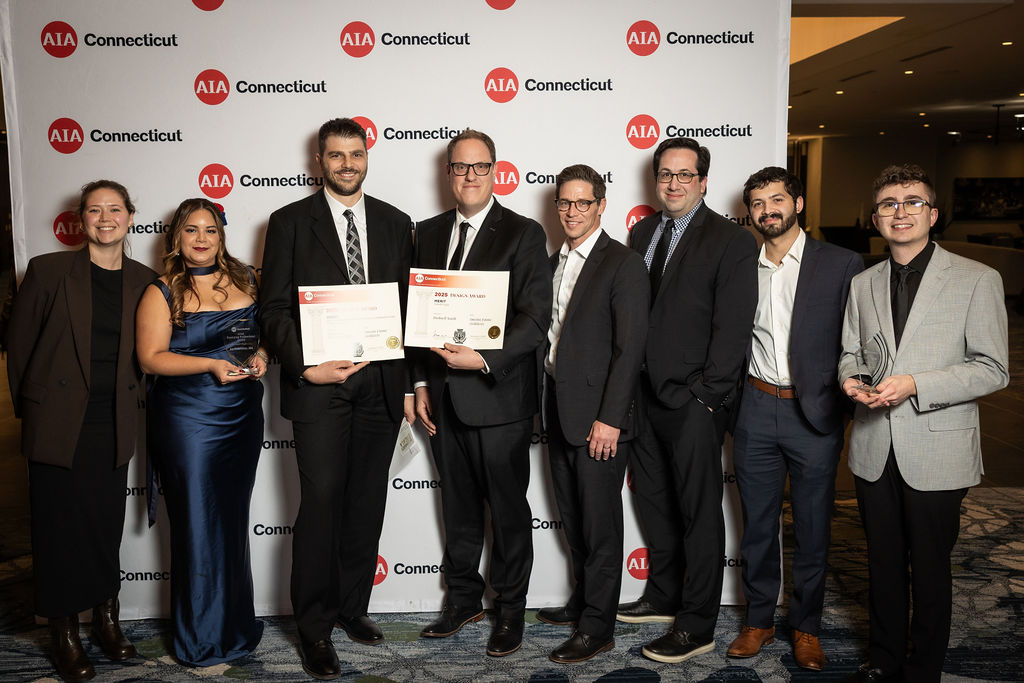
Bob Emma and Tony Amenta (center) with Principals (left to right) Myles Brown, Robert Swain, Michael Tyre, Jenna McClure, and Eric Weyant at the firm’s 40th Anniversary Celebration in September 2025.
As Tony prepares to close this chapter, Amenta Emma Architects continues under the leadership of President Michael Tyre and a team of Principals who have embraced the values Tony established 40 years ago: architecture that serves, communities that connect, and places that endure.
Those Roman streets set a young architecture student on a path. Forty years later, that path has transformed communities across New England.
We invite you to join us in wishing Tony the very best as he begins a new chapter – please email us here.